
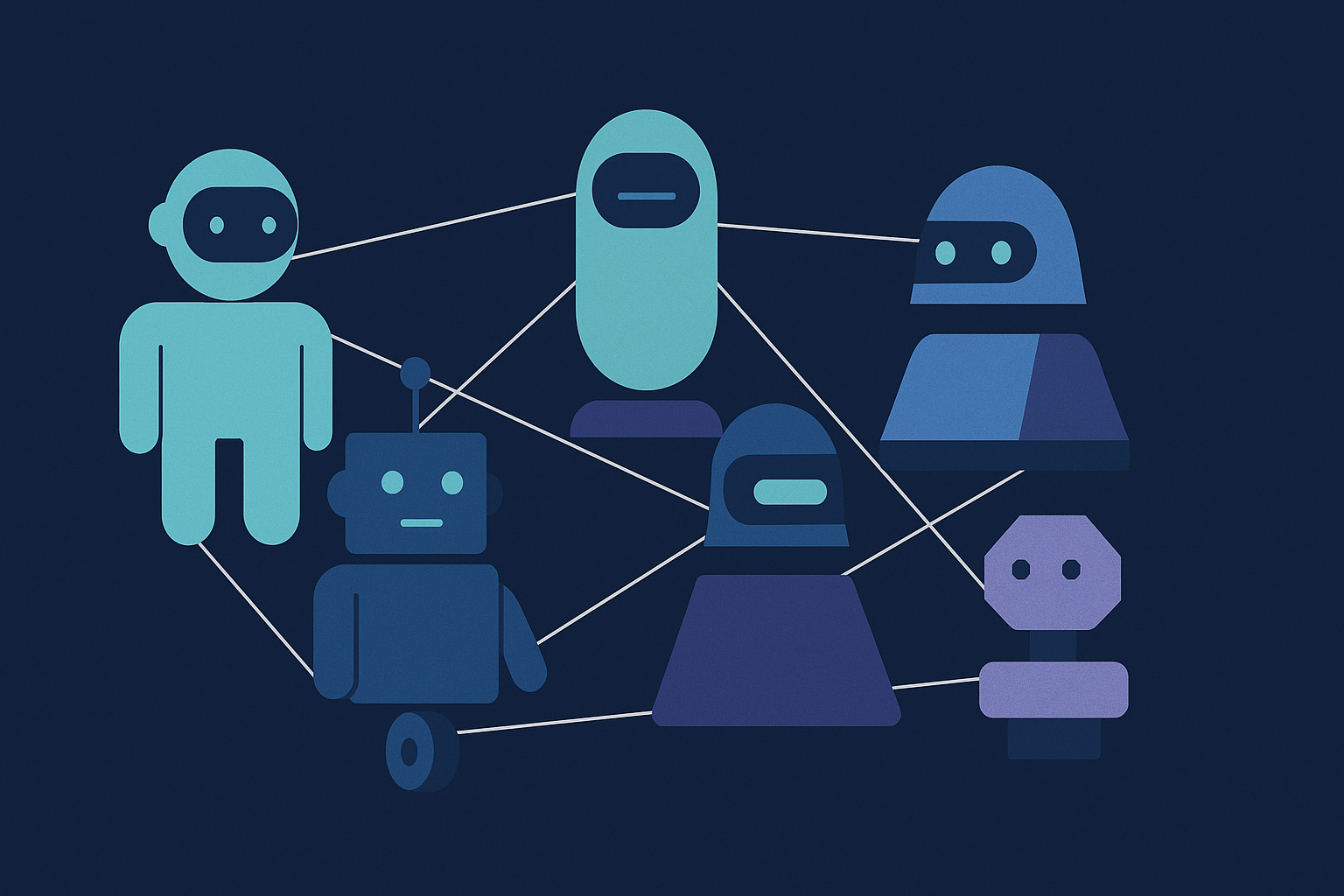
As enterprises move from simple copilots to networks of autonomous agents operating across applications, clouds, and business functions, governance, interoperability, and security become critical concerns. The Agent2Agent (A2A) Protocol has emerged as the industry’s first open, vendor‑neutral standard designed specifically to address these challenges. Creating a common language that allows AI agents to collaborate securely and transparently across systems and organizations.
Originally developed by Google and now donated to the Linux Foundation, and backed by Microsoft, A2A provides the foundational infrastructure for a future where agents communicate as freely as services do on the internet.
See: A2A Protocol [a2a-protocol.org]
1. What Is the A2A Protocol?
The Agent2Agent (A2A) Protocol is an open interoperability standard that enables AI agents (regardless of the framework, cloud, or vendor used) to securely communicate, exchange information, delegate tasks, and coordinate workflows.
A2A is designed to support:
- Structured agent messaging using standardized schemas
- Bidirectional communication and delegation across multiple agents
- Opaque, secure exchanges (agents do not expose internal memory or proprietary logic)
- Ecosystem interoperability, connecting agents built with LangGraph, Semantic Kernel, ADK, CrewAI, custom frameworks, and more
It is complemented—but not replaced—by the Model Context Protocol (MCP), which standardizes how agents connect to tools and APIs, while A2A governs agent‑to‑agent interactions.
2. What A2A Actually Provides
According to Google and the A2A specification:
2.1. A universal agent messaging format
A2A defines structured messages (based on JSON-RPC 2.0 in some implementations) to exchange tasks, data, results, and capabilities.
2.2. A decentralized agent identity and discovery system
Agents can find, register, and authenticate with each other across cloud boundaries.
2.3. Secure communication features
Latest versions include:
- gRPC support
- Signed security cards
- Extended SDK support (Python, JS, Java, .NET, Go)
2.4. Compatibility with MCP (Model Context Protocol)
A2A = agent-to-agent
MCP = agent-to-tool
Together they form a complete agent architecture.
3. Why A2A Matters for Governing Multi‑Agent Systems
3.1 Solves Fragmentation Across Agent Frameworks
Enterprises increasingly run agents across different SaaS platforms, internal systems, and cloud environments. Without a shared standard, each agent requires custom point‑to‑point integrations, creating brittle, unscalable architectures.
A2A removes this fragmentation by providing universal, framework‑agnostic interoperability, allowing agents built by different vendors to collaborate.
3.2 Enables Enterprise‑Grade Governance
As agents begin making decisions, triggering workflows, and taking actions autonomously, governance becomes essential. A2A supports governance by enabling:
- Auditability (standardized message formats allow for consistent logging)
- Access control and identity models built into the protocol
- Clear boundaries for what information agents may request or share
- Separation of capabilities (agents can interact without revealing internal systems or proprietary logic)
3.3 Supports Multi‑Cloud and Cross‑Organization Collaboration
Microsoft and Google jointly announced formal partnership around the A2A standard, ensuring it will work across ecosystems like Azure AI Foundry, Google Cloud, and Copilot Studio. This guarantees long‑term durability and cross‑industry adoption.
4. How A2A Is Standardized
The A2A protocol is governed through open‑source principles and contributions from a broad coalition of over 50+ major technology companies, including Salesforce, SAP, Intuit, MongoDB, Workday, and more.
Standardization components include:
4.1 Open Specification
A2A is defined via an openly published specification maintained by the Linux Foundation, ensuring transparency and community governance.
4.2 Consistent Message Format
Built on JSON‑RPC 2.0 with HTTP(S) transport in early implementations, and now adding gRPC support, A2A provides reliable, typed, interpretable messaging.
4.3 Standard Agent Capabilities (“Agent Cards”)
Agents declare their capabilities, metadata, security requirements, and operational limits using A2A’s standardized “Agent Cards,” increasing predictability and safe delegation.
4.4 Multi‑SDK Support
A2A provides official SDKs for:
- Python
- JavaScript
- Java
- C#/.NET
- Go
This ensures consistent implementation across engineering teams.
5. Decisions Enterprises Must Make When Implementing Agents Using A2A
Adopting A2A introduces architectural and governance decisions. Key considerations include:
5.1 Agent Identity and Authentication
Organizations must define:
- How agents are registered
- How identities are validated
- Which agents may communicate with internal or external peers
A2A supports identity and signature validation, but enterprises must define access policies.
5.2 Agent Delegation Boundaries
Decisions are needed around:
- What tasks agents are allowed to outsource
- Which agents can act autonomously
- Whether humans are required in certain approval loops
This reduces risk and prevents runaway decision‑making.
5.3 Data Strategy & Privacy Controls
Different agents may belong to different business units or external partners. Organizations must determine:
- What information agents may share
- Which fields must be masked or encrypted
- What internal data should never leave an organization’s domain
5.4 Observability and Monitoring
Enterprises need policies for:
- Logging agent communications
- Monitoring long‑running workflows
- Detecting anomalous or unauthorized behavior
5.5 Tooling and Integration Decisions
Because A2A can work alongside MCP‑based tools, teams must decide:
- Which capabilities belong in agents
- Which capabilities belong in tools
- How to structure the agentic workforce to minimize overlap and cost
6. Risks, Vulnerabilities & Security Considerations
While A2A strengthens agent governance, it also introduces new risks.
6.1 Untrusted or Malicious Agents
Agents across organizations may attempt to:
- Request unauthorized data
- Trigger harmful actions
- Misrepresent their capabilities
A2A mitigates this with signed agent cards and standardized identity mechanisms.
6.2 Message Manipulation or Interception
As with any protocol, communication channels could be compromised. A2A supports secure transport (HTTPS, gRPC) but enterprises must implement:
- TLS enforcement
- Message validation
- Signed payloads where appropriate
6.3 Over‑Delegation and Runaway Autonomy
Without strong governance, agents may recursively call other agents and generate:
- Excessive cost
- Logical errors
- Infinite loops
- Security escalation
Governance policies and limits are essential.
6.4 Misconfiguration Risks
A2A’s flexibility means:
- Incorrect capability definitions
- Poorly scoped agent permissions
- Weak discovery settings
…can expose sensitive surfaces.
7. Additional Security, Governance, and Efficiency Benefits
Despite the risks, A2A offers substantial value.
7.1 Security Enhancements
- Opaque boundaries: Agents interact without exposing internal logic or memory.
- Signature enforcement: Newer versions support secure signing of “security cards.”
- Cross-cloud trust model: Joint governance from Google and Microsoft ensures broad compatibility and secure extensions.
7.2 Efficiency Gains
- No custom integration per agent: Reduces engineering overhead across multi-agent ecosystems.
- Standardized messaging: Speeds up development and troubleshooting.
- Shared discovery mechanisms: Agents can quickly find and collaborate with each other.
7.3 Enterprise-Wide Scalability
Because A2A is open and universal, enterprises can:
- Scale from a handful to thousands of agents
- Swap or update agent vendors without breaking workflows
- Maintain consistent governance across business units
8. Conclusion
The Agent2Agent (A2A) Protocol represents a foundational leap for enterprise AI (much like HTTP did for the early internet). By establishing an open, secure, standardized channel for agents to collaborate, A2A enables organizations to scale safely from individual copilots to fully autonomous agent networks.
Enterprises adopting agents in 2026 and beyond should view A2A as a core part of their AI governance, architecture, and security strategy, not just a communication layer, but the backbone of future-ready agentic systems.
Modern Applications and Power Platform Solutions Architect at Velrada.
Technical Consultant Helping organizations unlock the full potential of their Microsoft efficiency tools.
Feel free to share your thoughts or connect with me to discuss AI or Microsoft efficiencies.
Leave a Reply