
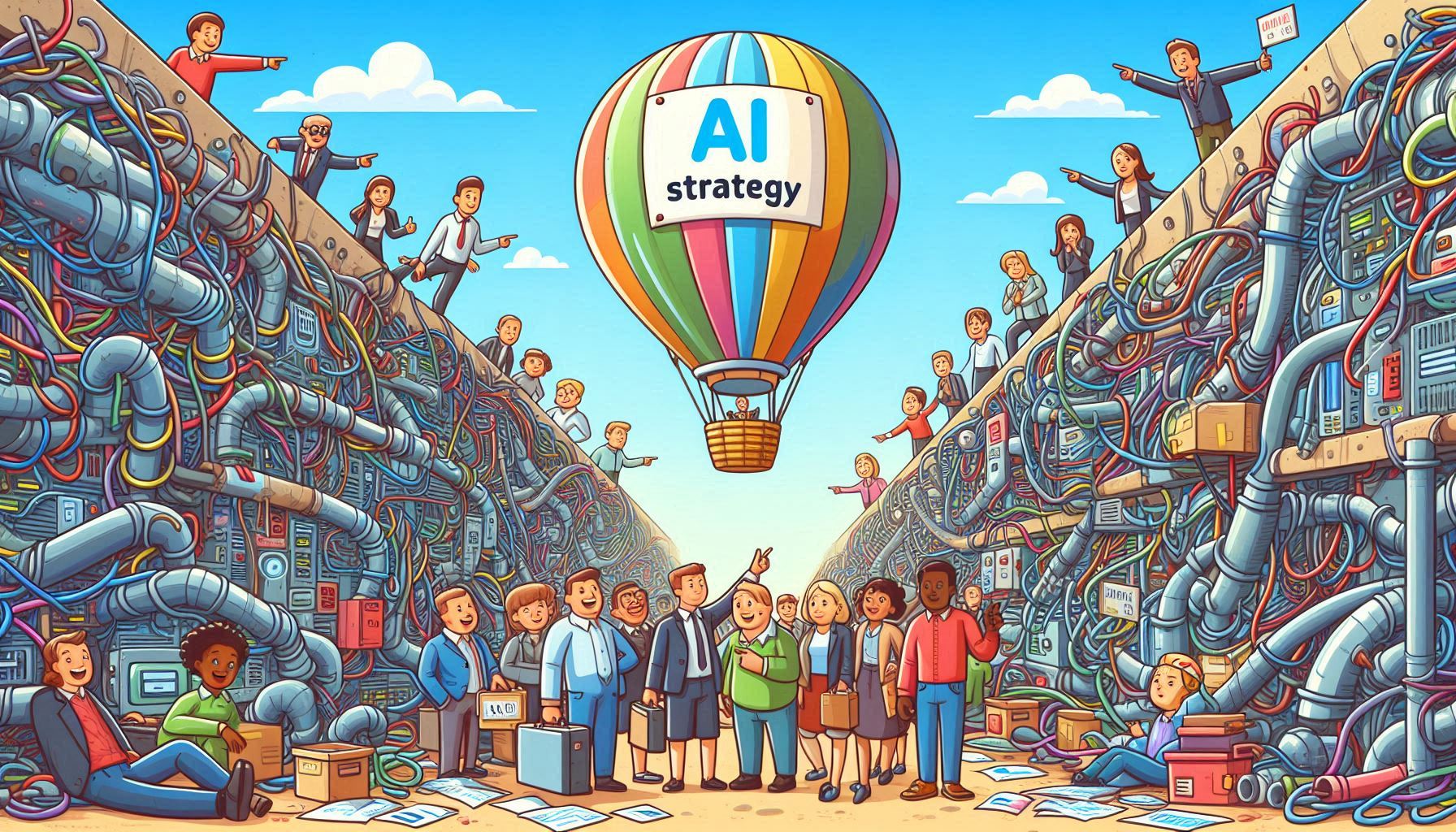
One of the biggest mistakes I see is organisations starting with:
“We need an AI strategy.”
Well sure… But more than that… you need a business strategy that includes AI.
AI is not the goal. It’s a lever.
If you don’t anchor it to tangible outcomes, you’ll end up with:
- disconnected pilots
- duplicated tools
- shadow AI usage
- and leadership asking why nothing is scaling
- no ROI
The shift that works:
Start with:
- Where are we losing time?
- Where are decisions slow or inconsistent?
- Where is knowledge trapped in people or systems?
That’s where AI belongs.
A Practical Starting Framework (That Actually Works)
Forget the 50-slide strategy decks. If you’re leading this, focus on three layers:
1. Envision (But Keep It Grounded)
Define 3–5 high-value use cases, not 20.
Good examples:
- Automating [this specific process] repetitive decision-making processes
- Enhancing [this specific process] customer interactions (not replacing them)
- Reducing manual data handling across [this specific system]
- Assisting internal teams with knowledge retrieval for [this specific process]
Bad examples:
- “Let’s build a chatbot”
- “Let’s use AI everywhere”
If it doesn’t tie to a measurable outcome, it’s a distraction.
2. Control (Before You Scale)
This is where most organisations cut corners (and regret it later).
You need early governance, not retrofitted governance.
At minimum:
- Data boundaries: What can and cannot be used by AI
- Environment strategy: Where AI solutions live (especially in platforms like Power Platform)
- DLP policies: Prevent data leakage across connectors
- Auditability: Can you explain what the AI did and why?
If you skip this, you won’t be able to scale safely, and someone will eventually shut it down.
3. Execute (Small, Fast, Iterative)
Your first AI solutions should:
- Deliver value in weeks, not months
- Be low-risk but visible
- Prove ROI quickly
Think:
- AI-assisted workflows
- Copilot-style augmentations
- Internal productivity wins
Not:
- Fully autonomous, business-critical decision engines
You’re building trust (not just technology).
Where Most AI Strategies Go Wrong
Let’s be honest about the traps.
❌ 1. Overengineering Too Early
Trying to design the “perfect future-state AI platform” before delivering anything.
You don’t need perfection. You need momentum.
❌ 2. Ignoring the Human Layer
AI doesn’t fail because of technology.
It fails because:
- people don’t trust it
- people trust it too much
- people don’t understand it
- people feel replaced by it
If your strategy doesn’t include:
- enablement
- transparency
- accountability
- communication
- and clear positioning (AI as an assistant, not a threat)
…it will stall.
❌ 3. No Ownership Model
Who owns AI in your organisation?
- IT?
- Business units?
- Innovation teams?
If the answer is “everyone,” the reality is “no one.”
You need:
- clear ownership
- defined operating model
- governance that enables, not blocks
Sometimes multiple aspects can be owned by different teams. IT and Business units. As long as it’s known, clear and defined who’s in charge of what then you’re on the right track.
❌ 4. Treating AI Like Traditional Software
AI is probabilistic. It’s unlikely you can test for every scenario or outcome.
That means:
- outputs can vary
- accuracy isn’t binary
- validation is ongoing
If your QA, testing, and governance models assume deterministic systems, you will struggle.
The Overlooked Risks (That Bite Later)
These are the ones I see catch even experienced teams off guard:
⚠️ Data Leakage Through Convenience
Users will always choose ease over policy.
If governance isn’t built into the tools they use, they’ll:
- paste sensitive data into public AI tools
- create shadow solutions
- bypass controls entirely
⚠️ “Invisible” Technical Debt
AI solutions built quickly without structure become:
- impossible to maintain
- hard to explain
- risky to scale
Especially in low-code platforms, governance matters even more here.
⚠️ False Confidence in Outputs
AI can sound right while being wrong.
If you don’t design for:
- human validation
- specific prompts for non-hallucination
- feedback loops
- confidence thresholds
You’re creating risk, not efficiency.
⚠️ Scaling Before Standardising
If every team builds AI differently:
- governance becomes chaos
- duplication explodes
- support becomes unsustainable
Standard patterns early. It pays off massively later.
What I’d Do If I Were Starting Today
No fluff. Just action.
Week 1–2:
- Identify 3 high-value use cases
- Define success metrics
- Align stakeholders
Week 3–6:
- Deliver 1–2 pilot solutions
- Implement baseline governance (DLP, environments, data rules)
- Capture feedback and iterate
Month 2–3:
- Establish a Center of Excellence
- Define reusable patterns
- Start scaling what works
Ongoing:
- Invest in enablement (this is non-negotiable)
- Continuously refine governance
- Measure impact, not activity
Final Thought
AI isn’t about replacing people.
It’s about removing friction from how people think, decide, and act.
The organisations that will win here aren’t the ones with the most advanced models.
They’re the ones who:
- stay grounded in business value
- move quickly but responsibly
- show up to scheduled accountability meetings
- and bring their people along with them
Right now, most teams are still in that “bubble” of observing, experimenting and unsure.
The goal isn’t to escape that overnight.
It’s to move forward deliberately with clarity, structure, and intent.
Leave a Reply