
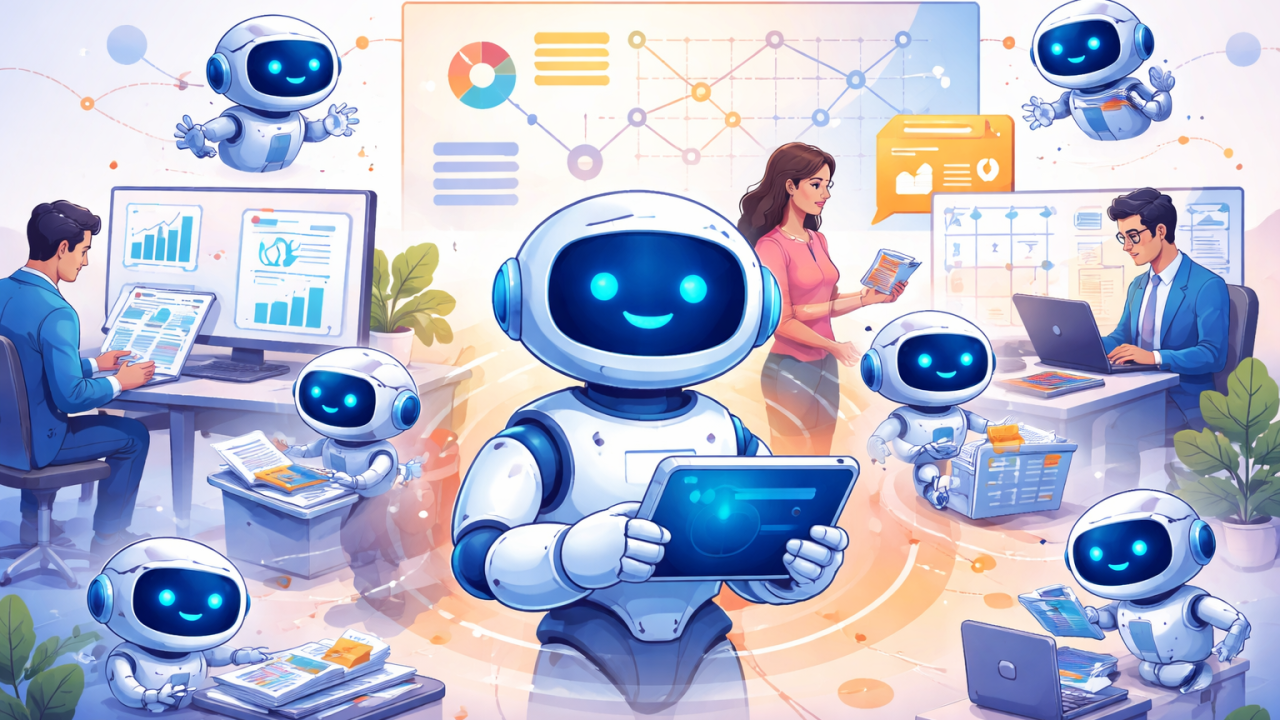
When most people think about AI at work, they picture a chat window.
Ask a question. Get an answer. Repeat.
Chat is useful, but it’s only one interface. And in many business scenarios, it’s not even the best one.
The real shift happening right now is autonomous agents: AI that doesn’t wait for you to ask, but instead acts inside your workflows.
Let’s break that down.
What Is an Autonomous Agent?
An autonomous agent is AI that can:
- Observe events or changes
- Make decisions based on rules, context, or goals
- Take actions across systems
- Loop, retry, escalate, or stop when needed
All without a human typing a prompt every time.
You don’t “chat” with it constantly. You design the outcome, and the agent works in the background to achieve it.
Think less assistant… more digital team member.
Chat Is an Interface: Not the Job
Chat is great when:
- You need ideas
- You’re exploring or learning
- You want a quick answer
But most business value doesn’t come from asking questions. It comes from getting work done.
And work usually looks like:
- A record changes
- A request is submitted
- A threshold is crossed
- A deadline approaches
- Data doesn’t look right
That’s where agents shine — embedded directly into workflows.
What Does This Look Like in Practice?
Here are some real-world examples.
1. Incident & Support Management
Instead of:
“Hey AI, can you help me triage this ticket?”
An autonomous agent:
- Detects a new high-priority ticket
- Reviews historical incidents
- Suggests likely root cause
- Drafts a response
- Assigns the right team
- Escalates if SLAs are at risk
No chat window required. The agent operates inside the process.
2. Finance & Exception Handling
Instead of:
“Can you check if these invoices look right?”
An agent can:
- Monitor incoming invoices
- Flag anomalies based on past patterns
- Request missing documentation
- Route only true exceptions to humans
- Learn from approvals and rejections over time
Humans handle judgment calls. AI handles the noise.
3. HR & Employee Onboarding
Rather than answering the same questions in chat:
- An agent triggers when a new employee is created
- Provisions access
- Schedules onboarding tasks
- Sends personalised content by role
- Checks completion and follows up automatically
Employees experience a smooth journey. HR doesn’t chase checklists.
4. Data Quality & Governance
Instead of:
“Why does this report look wrong?”
An agent can:
- Monitor data pipelines
- Detect anomalies or missing data
- Validate against business rules
- Notify owners
- Suggest fixes or rollbacks
AI becomes a guardian of quality, not just a reporting tool.
Why This Matters
Autonomous agents change how we think about AI:
- From interaction → to orchestration
- From answers → to actions
- From tools → to teammates
The biggest gains don’t come from better prompts. They come from better process design.
The Architect’s Mindset Shift
If you’re designing systems today, the key questions aren’t:
“Where do we add a chat bot?”
They’re:
- Where do decisions repeat?
- Where do humans add the least value?
- Where does context already exist in the system?
- What should happen automatically vs with oversight?
That’s where autonomous agents belong.
Final Thought
Chat will always have a place.
But the future of AI at work isn’t a conversation. It’s quiet, reliable execution happening in the background, triggered by real business events, governed by rules, and guided by human intent.
And that’s where the real productivity gains are.
Leave a Reply