
AI is everywhere right now. But adoption? That’s where most organizations stall.
If you’re leading AI conversations in your business, you’ve probably noticed something:
Everyone wants AI. Few are ready for it.
That’s exactly why the Microsoft AI Adoption Framework exists.
What is the AI Adoption Framework?
The AI Adoption Framework is a structured approach designed to help organizations adopt AI responsibly and at scale.
It is not about building a model. It is not about choosing a tool. It is not about “switching on Copilot.”
It’s about building the organizational capability to use AI well.
The core principle is simple:
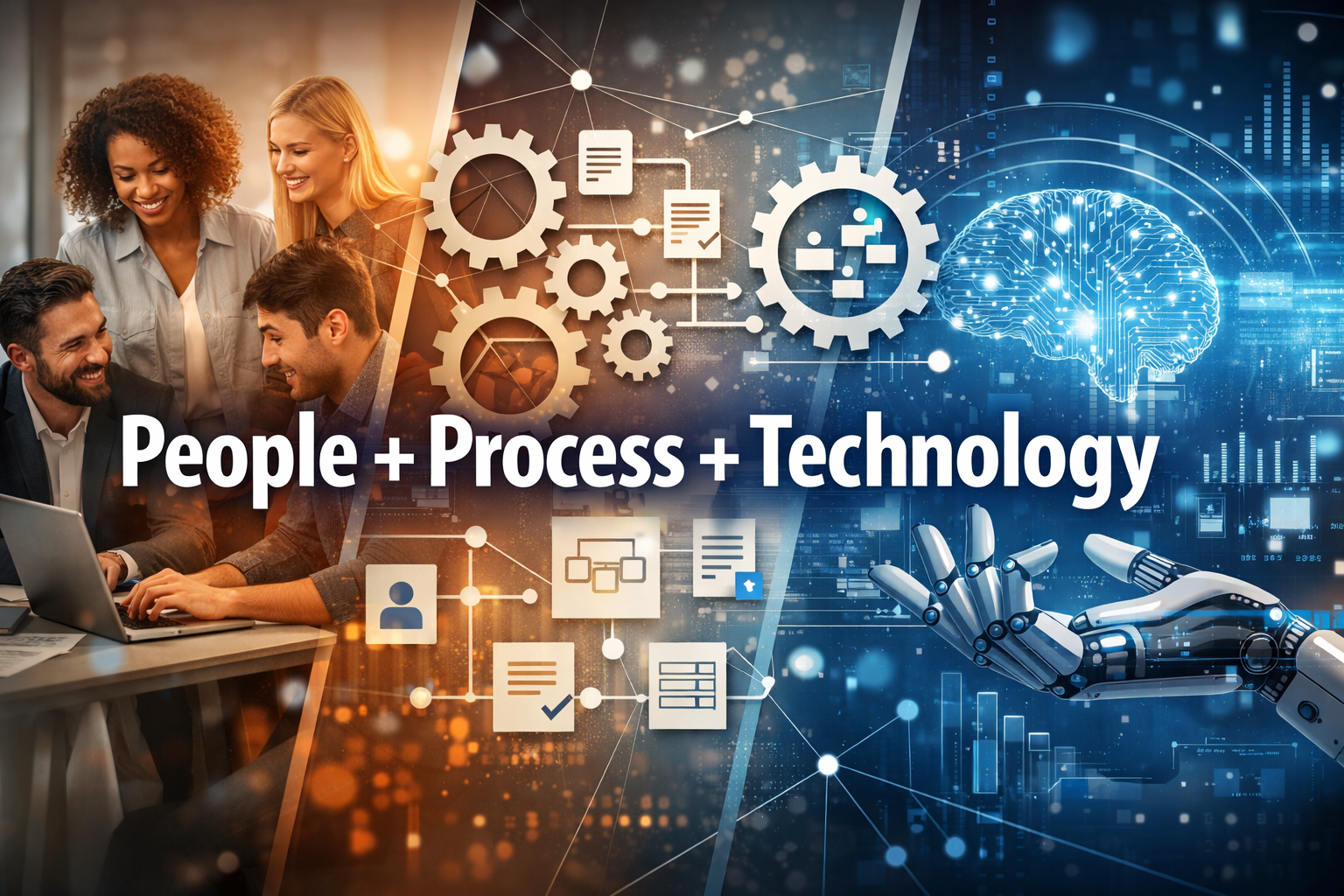
People + Process + Technology
If one of those is missing, AI initiatives either stall… or create risk.
The Core Idea: It’s Not “Just Deploy AI”
Many organizations treat AI like a software rollout.
It isn’t.
AI changes:
- How decisions are made
- How people work
- How risks are managed
- How value is measured
If you focus only on the technology layer, you’ll miss the real transformation work.
The framework forces leaders to think beyond tools and into capability.
Key Components of the Framework
1. Strategy & Readiness
Before you touch a model, ask:
- What business problems are we solving?
- Where will AI create measurable value?
- Do we have the data maturity to support this?
- Are leaders aligned?
AI without strategy becomes experimentation theatre.
Strong adoption starts with:
- Clear executive sponsorship
- Defined priority use cases
- Readiness assessment across people, process, and data
If your strategy is “we should probably use AI,” you’re not ready.
2. Governance & Responsible AI
This is where many organizations underestimate the work.
Responsible AI isn’t a policy document. It’s embedded practice.
Key considerations:
- Accountability and ownership
- Transparency in outputs
- Bias and fairness controls
- Privacy and data boundaries
- Auditability and traceability
Embedding Responsible AI from day one prevents:
- Shadow AI
- Compliance breaches
- Reputational damage
- Internal mistrust
Guardrails are not blockers. They’re enablers of scale.
3. Adoption & Change Management
This is the part most technical teams skip.
AI fails when:
- Users don’t trust it
- Leaders don’t model its use
- Teams aren’t trained properly
- Success isn’t communicated
Upskill users — not just developers.
That means:
- Clear usage guidelines
- Real business scenarios
- Training aligned to roles
- Space for experimentation
Adoption is a behavior shift, not a feature release.
4. Value Realization
AI excitement doesn’t equal ROI.
The framework emphasizes defining success metrics early.
Ask:
- What does “better” look like?
- Are we saving time, reducing cost, improving quality?
- How will we measure it?
- How often will we review impact?
If you can’t measure it, you can’t justify scaling it.
Best Practices (In Plain English)
Here’s what actually works in practice:
- ✔ Start with business problems, not models
- ✔ Define success metrics before deployment
- ✔ Embed Responsible AI from day one
- ✔ Upskill users, not just technical teams
- ✔ Treat AI as a transformation program, not a tool rollout
If your initiative feels like “install and hope,” pause.
Limitations of the Framework
This is important.
The AI Adoption Framework is high-level guidance.
It:
- Does not provide architecture diagrams
- Does not prescribe specific tools
- Requires organizational maturity to execute well
It gives direction. Not implementation blueprints.
If you need technical design patterns, this isn’t the document you’re looking for.
When Should You Use It?
This framework is most valuable when:
- You’re in early AI planning stages
- You’re leading executive conversations
- You’re building enterprise-wide guardrails
- You’re justifying AI investment
- You need to align governance and strategy
If the conversation includes words like: “readiness,” “governance,” “risk,” “enterprise,” or “strategy”, this framework applies.
Why It Matters
AI done poorly creates:
- Risk
- Distrust
- Waste
- Tool fatigue
AI done well creates:
- Measurable business value
- Competitive advantage
- Empowered teams
- Scalable innovation
The difference is rarely the model.
It’s organizational maturity.
The AI Adoption Framework doesn’t make AI magical.
It makes AI sustainable.
And if you’re advising clients, leading transformation, or sitting in strategy rooms, that’s the difference that actually matters.
If you’re working through AI readiness in your organization, what’s been the biggest blocker: strategy, governance, or user adoption?
Leave a Reply