

Here’s the truth: most people are told networking matters… but almost no one is taught how to actually do it.
So what happens? People either avoid it entirely, or they swing too far the other way and come across forced, transactional, or (let’s be honest) a bit annoying.
That’s not a personality problem. It’s a skills gap.
Let me help add some perspective.
A Simple Way to Think About Networking
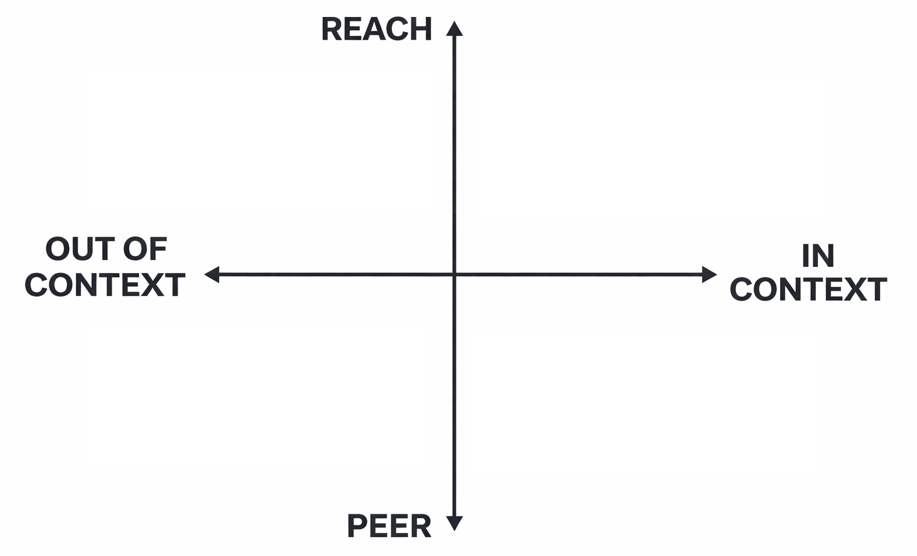
Imagine a basic 2×2 matrix:
➡️Horizontal axis:
- Out of context of work (social settings)
- In context of work (professional settings)
⬆️Vertical axis:
- Reach (people ahead of you)
- Peer (same level)
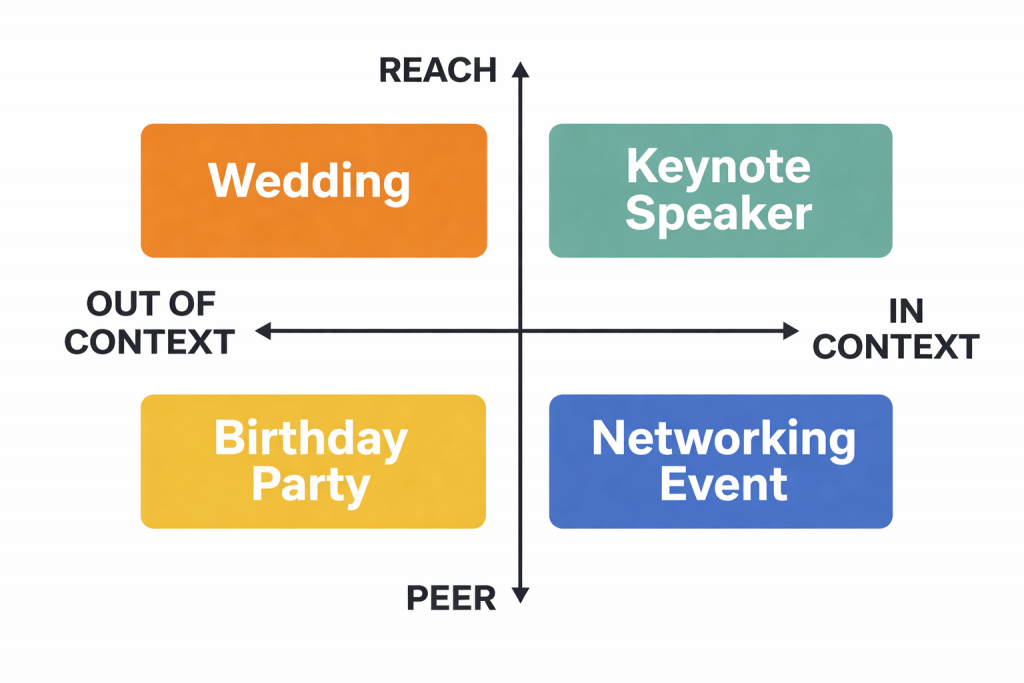
This gives you a matrix with four quadrants representing very different networking scenarios, and each one needs a slightly different approach.
The 4 scenarios
Lets discuss 4 distinct networking example scenarios that fall into this matrix.
- Out of Context + Reach: Going to a friends weddings, at the bar, the woman next to you is a VP at a huge company in your industry. You get to talking, tell her about yourself and say you’ll stay in touch. Huge coincidence. Very rare. Golden opportunity.
- Out of Context + Peer: Sporting event or Birthday Parting. Mate’s cousin also works in the industry. Chat, share socials and connect. One of you may not always be at your current level, and jobs change. It helps to know people.
- In Context + Peer: Intentional Networking event. Like the Australian Biz Apps User Group or similar where you meet someone at your level within the context of your work.
- In Context + Reach: At an industry conference, you go up to the key note speaker to tell them it was a great talk, what you liked and connect on Linkedin.
Now lets dive into how to handle being memorable for each of these unique scenarios.
1. Reach Networking (Out of Context)
Example: Wedding, party, random social event
This is the “lightning strike” scenario. You’re not there to network… and suddenly you’re talking to someone senior in your industry out of context of your work.
How to approach it
Don’t turn it into a business pitch. That’s where people go wrong.
You’re a human first, not a walking LinkedIn profile.
What to say
Start normal:
- “How do you know the host?”
- “What do you do during the week?”
When you realise there’s alignment:
- “No way, I’m in that space too. I work on [simple version of your role].”
Keep it light. No jargon. No overselling.
How to introduce yourself
Use a one-line, non-intimidating version of your work:
- “I help businesses streamline their processes using Microsoft tools.”
- Not: your full title, certifications, and career history.
How to follow up
This is where most people fumble.
Say:
- “I’ve really enjoyed chatting, would you be open to connecting on LinkedIn?”
Then follow up within 24–48 hours:
- Reference the moment
- Keep it short
Example:
“Great meeting you at Sarah’s wedding, still can’t believe we ended up in the same industry! Would love to stay in touch.”
Key rule: No ask. Just connection.
2. Peer Networking (Out of Context)
Example: Birthday, sports event, mutual friend gathering
This one is massively underrated.
Because today’s peer could be tomorrow’s hiring manager, client, or collaborator.
How to approach it
This is about relationship-building, not opportunity-hunting.
What to say
Let it evolve naturally:
- “What kind of work are you in?”
- “What’s that like day to day?”
If there’s overlap:
- “We’re dealing with similar things, it’d be great to swap notes sometime.”
How to introduce yourself
Keep it relatable:
- “I work in tech, mostly helping teams build apps and automate processes.”
You’re aiming for connection, not impression.
How to follow up
This is where you can go slightly deeper than reach networking.
Example:
“Really enjoyed our chat about [topic] at Jess’s birthday, keen to continue that conversation sometime.”
You can suggest:
- A coffee
- Sharing an article
- Introducing them to someone useful
Key rule: Play the long game. Careers grow. So do people.
3. Peer Networking (In Context)
Example: User groups, meetups, internal events
This is the safest environment, and ironically where people still struggle.
Why? Because everyone knows it’s networking… so it feels forced.
How to approach it
Drop the pressure to “network.” Focus on shared experience.
What to say
Start with context:
- “What brought you here today?”
- “What did you think of that session?”
Then go one level deeper:
- “Are you working on something similar at the moment?”
How to introduce yourself
Be slightly more specific here:
- “I’m a solution architect working with Power Platform, mainly focused on [problem you solve].”
How to follow up
You have permission to be more intentional.
Example:
“Great chatting at the Biz Apps meetup, loved your perspective on governance. Would be great to stay connected.”
Optional next step:
- “If you’re open, I’d love to compare approaches sometime.”
Key rule: Add value early, share something useful, not just your profile.
4. Reach Networking (In Context)
Example: Conference, keynote speaker, industry leader
This is where most people either:
- Say nothing… or
- Say something awkward and forgettable
You don’t need to be impressive. You need to be specific.
How to approach it
They’ve just spoken to hundreds of people. Generic praise gets forgotten instantly.
What to say
Instead of:
- “Great talk!”
Say:
- “You mentioned [specific point], that really resonated because [your context].”
That’s how you stand out.
How to introduce yourself
Keep it tight:
- “I’m Kim, I work in Power Platform, focusing on [area].”
Then bridge:
- “I’d love to stay connected if that’s okay.”
How to follow up
This one matters.
Example:
“Really appreciated your talk on [topic], especially your point about [specific insight]. It’s directly relevant to what I’m seeing in my work.”
Optional:
- Share how you’re applying it
- Ask a light question
Key rule: Show you listened. That’s rare, and memorable.
Final Thoughts: Networking Without Being “That Person”
If networking feels uncomfortable, it’s usually because it feels transactional.
So flip it.
Instead of asking:
- “What can I get from this?”
Ask:
- “What’s a genuine way to connect here?”
Or Even:
- “What do I have to [genuinely/unconditionally] offer them?”
A few grounded rules:
- Keep introductions simple
- Stay curious longer than feels natural
- Don’t rush the “ask”
- Follow up like a human, not a template
And most importantly…
Consistency beats intensity. You don’t need one perfect interaction. You need many small, genuine ones over time.
That’s how real networks are built.
Leave a Reply